

Your posture score
At the top of the dashboard, Athena rolls everything it knows about your environment into one score from 0 to 100 with a matching A–F grade. Beside it you get the 30-day change in points, how many targets the score covers, and a Generate report button that turns the whole picture into a document. Two sub-scores sit just below, because they answer different questions: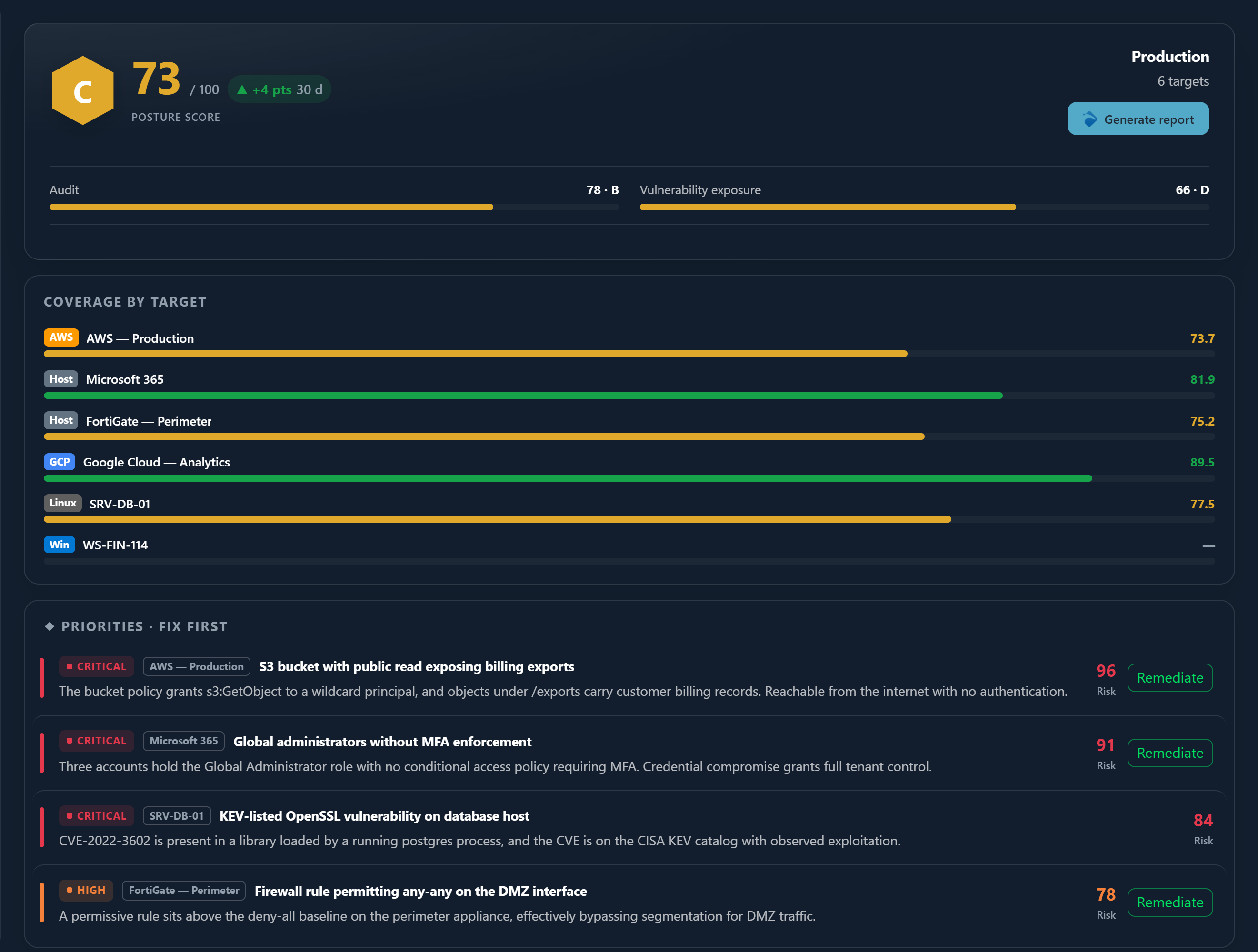
What the dashboard shows
The dashboard is a sequence of panels, each answering a different question. From the top:Coverage by target
Every audited device and integration, ranked worst first, with its own score
and a bar you can read at a glance. Targets with nothing collected yet show
a dash instead of a score.
Priorities · Fix first
The findings that matter most, each with its severity, the target it affects,
a plain-language explanation, a Risk score, and a Remediate button
that hands the fix to chat.
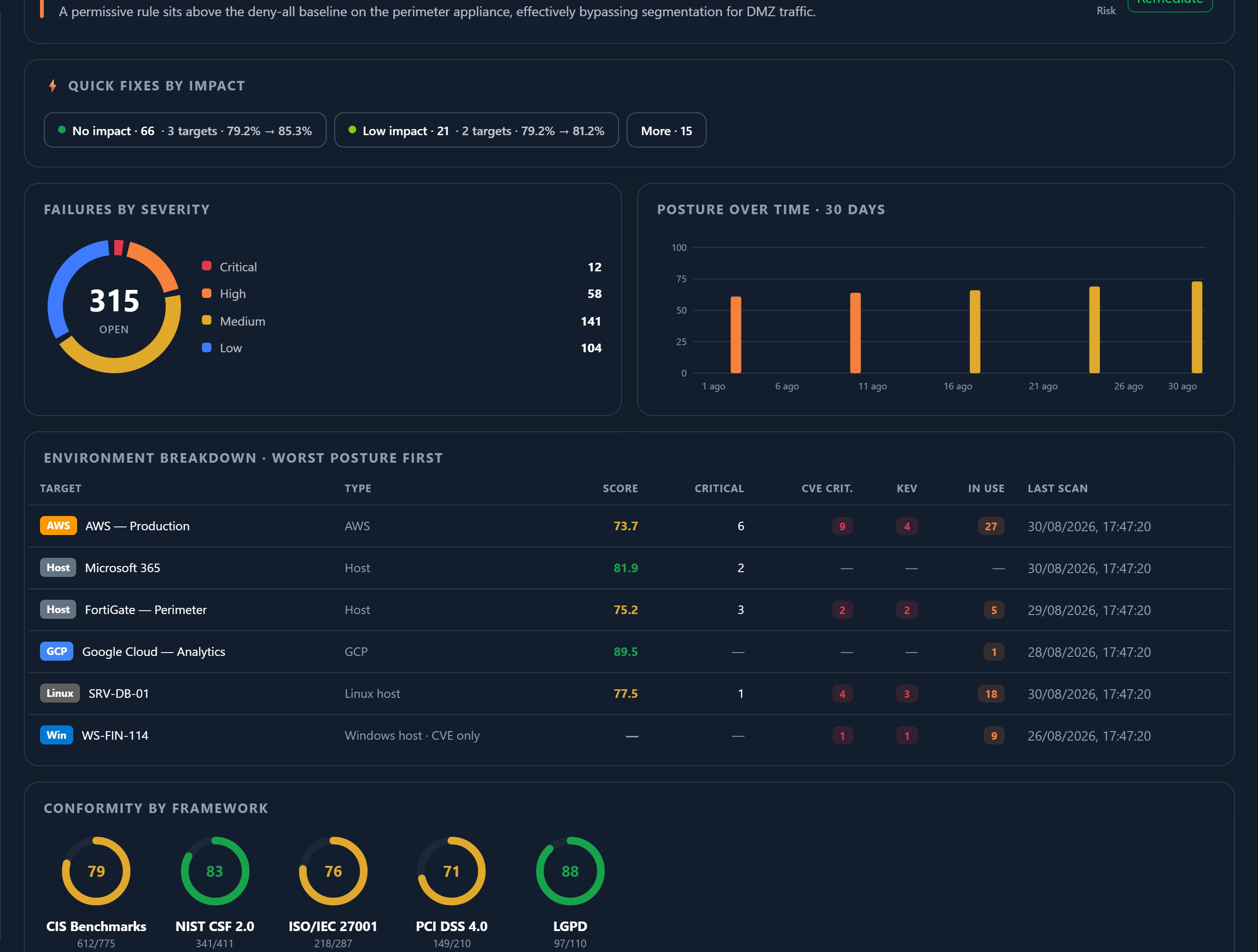
Quick fixes by impact
Fixes grouped by how disruptive they are — No impact, Low impact, and
the rest — each showing how many findings it covers, across how many targets,
and what your score would become if you applied them.
Failures by severity
A donut with the total open failures, broken down into Critical, High,
Medium and Low.
Posture over time · 30 days
Your score day by day over the last month, so you can see whether you’re
gaining or losing ground.
Environment breakdown
A table of targets, worst posture first, with the target’s type, its score,
and its counts of critical findings, critical CVEs and KEV entries.
Coverage against frameworks
Two panels place your environment against external references. MITRE ATT&CK breakdown shows how many techniques you cover, fail and leave uncovered, laid out by tactic:Reconnaissance, Resource Development, Initial Access, Execution, Persistence, Privilege Escalation, Defense Evasion, Credential Access, Discovery, Lateral Movement and Collection.
Conformity by framework gives each framework its own gauge, with the score and the number of controls passing out of the total. Which frameworks appear depends on what applies to your environment; the set typically includes CIS, ISO 27001, NIST CSF, PCI DSS, SOC 2, HIPAA, LGPD, MITRE ATT&CK and Bacen, alongside per-platform baselines for macOS, Windows, Linux and for connected tools such as Wazuh, Bitdefender, Mikrotik, GLPI and Elastic Security.
Smart re-categorization
Not every scanner verdict survives contact with your environment. Smart re-categorization shows the findings Athena re-evaluated against the real context — a raw severity downgraded when the platform proved it was noise, or elevated when real exposure made it worse than the scanner said. Each one carries its identifier, the severity it moved from and to, and the reasoning behind the move.The controls table
At the bottom, Controls lists every control evaluated across your environment — hundreds of them. Search by control, resource or region, and filter by status, severity and category. Each row shows the control, its category, its severity, how many resources are failing it, and how many resources it covers.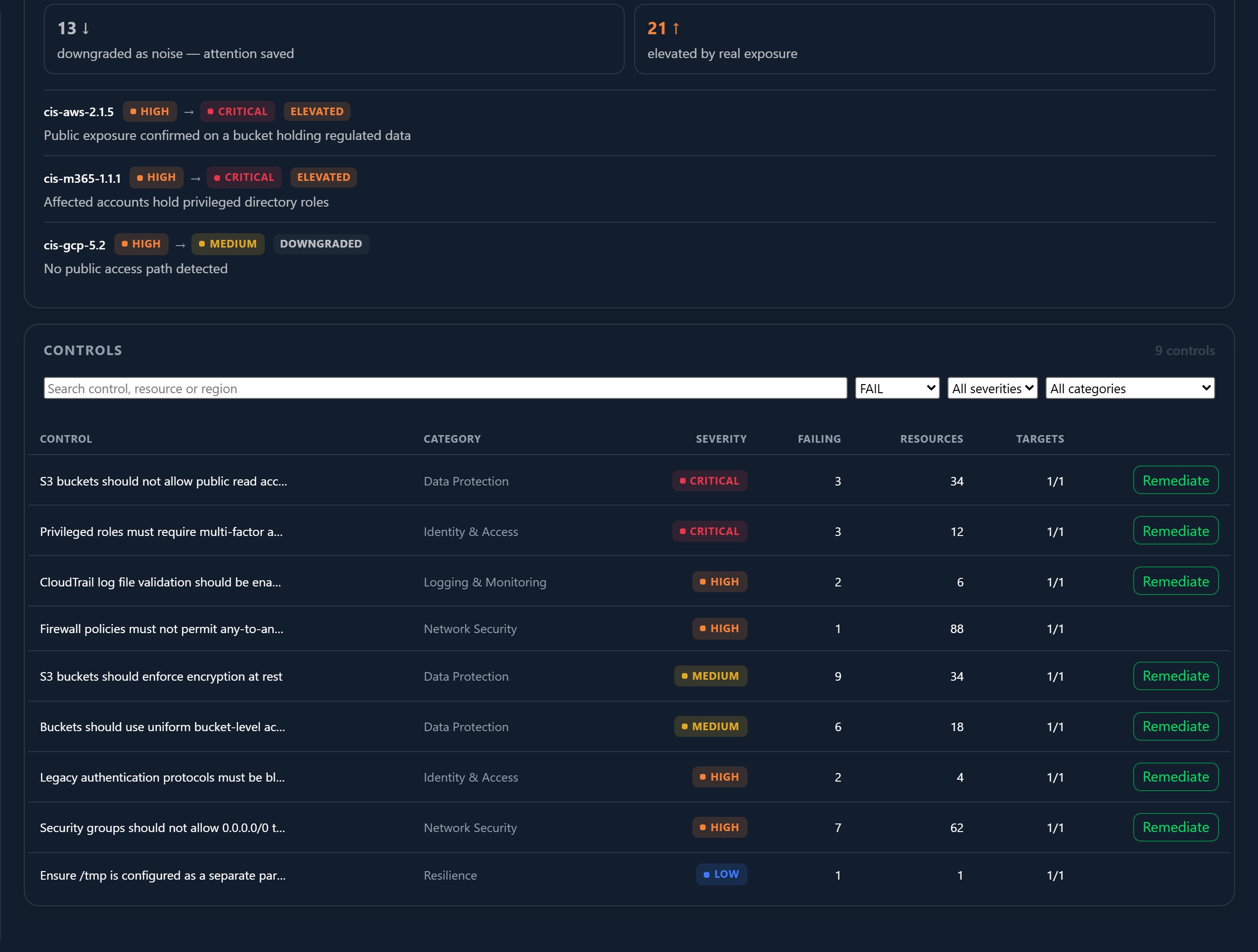
Acting on what you find
The dashboard shows the picture; the work happens in chat, where Athena and the specialist agents do it. From a finding you can:Send to chat
Drop the finding into the conversation to understand it before deciding,
without changing anything.
Remediate
Hand the fix to chat, where Perseus acts on a host or Hydra acts on an
integration.
Accept the risk
Silence a finding you’ve decided to live with, behind a signed
risk-acceptance document.
Where to go next
Remediation & risk acceptance
Remediate, send to chat, silence and reactivate findings.
Frameworks & scanning
The frameworks covered and how the 24-hour scans run.
Athena
Meet the agent behind Security Posture.
Detection & response
Posture is proactive; the SOC handles live threats and alerts.